Healix · preventive health
Sergei Petryk and Healix: the clinic of the future starts with a photo of the eye
Sergei Petryk 13 min read

Healix assesses a person's wellness from a smartphone photo of the eye: the frame captures the sclera, the conjunctival blood vessels, the iris and the pupil, and the person gets a wellness map and a plan for two to three months. The method grew out of five years of practice, from 2018 to 2023, with a database of about 3,000 people. In 2023, a Google study in The Lancet Digital Health showed that a model can detect signs of reduced kidney function and anemia from an external photo of the eye.
Below, in order: why the eye, what research stands behind it, how Healix works, what the clinic of the future consists of and where the method's limits lie today.
Blood vessels and blood color are visible in the eye without a needle
Doctors were reading the eye long before neural networks. Yellowing of the white of the eye suggests high bilirubin in the blood, and a pale inner eyelid is considered a sign of anemia. The front of the eye is fully open to view: a transparent membrane over the white, a network of fine blood vessels beneath it, then the iris and the pupil.
Today this kind of examination can be digitized. A camera captures the shade of the sclera, the pattern and density of the vessels, shape and symmetry. In research, the next step is this: a model is trained on thousands of images for which lab results are known, and it learns to find patterns that a person notices only at a late stage or not at all.
For me, the key word in this story is "without." No needle, no waiting list and no lab at the first step. That decides how often a person is willing to check in on themselves.
Five studies I rely on when talking to partners
These are peer-reviewed studies by other teams, not Healix results. They answer one question: does a photo of the eye contain information about the state of the whole body? The answer is yes: the information is there both in the retina and in the front of the eye, and some of the signs can be captured with an ordinary phone.
| Year and team | What was photographed | What the model found | Sample |
|---|---|---|---|
| 2017 University of Washington, the BiliScreen app | The sclera, with a smartphone camera | Elevated bilirubin, that is, jaundice as a sign of liver and pancreatic disease. Sensitivity 89.7%, specificity 96.8% with an accessory that blocks outside light | 70 people |
| 2018 Google, Nature Biomedical Engineering | The retina, with a dedicated fundus camera | Age with an average error of 3.26 years, smoking, systolic blood pressure with an error of about 11 mmHg | 284,335 patients in training |
| 2021 Brown University, PLOS ONE | The inner eyelid, with a smartphone | Anemia: 72.6% accuracy on new patients | 344 patients |
| 2022 Google, Nature Biomedical Engineering | The front of the eye | Signs of diabetic retinal damage and poor blood sugar control | 145,832 patients in development, 48,644 in validation |
| 2023 Google, The Lancet Digital Health | The front of the eye | Reduced kidney function, anemia, abnormal levels of the liver enzyme AST, platelets and calcium | 38,398 patients in training, 25,510 in validation |
Two caveats, or this table would read like an ad. First: the accuracy of these models is far from lab accuracy. In the 2023 study, the area under the ROC curve, the standard measure of a classifier's quality, ranged from 62 to 88 percent, and the authors state plainly that more work is needed before clinical use. Second: the external photos in both Google studies were taken with tabletop cameras with a head rest.
The next step for the whole field is obvious: the phone. Google has reported that, together with partners in Taiwan, India and the US, it is collecting images taken with smartphones. Healix is designed for exactly that kind of photo, and that is our bet: the first step should be available where there's no fundus camera and no waiting list for an eye doctor.
How Healix reads a photo of the eye
A person photographs their eye with a smartphone, and the whole front of the eye is in the frame: the sclera, conjunctival vessels, iris and pupil. We don't photograph the retina. That requires a special camera and a dilated pupil, and the whole point of Healix is that the first step doesn't need a clinic.
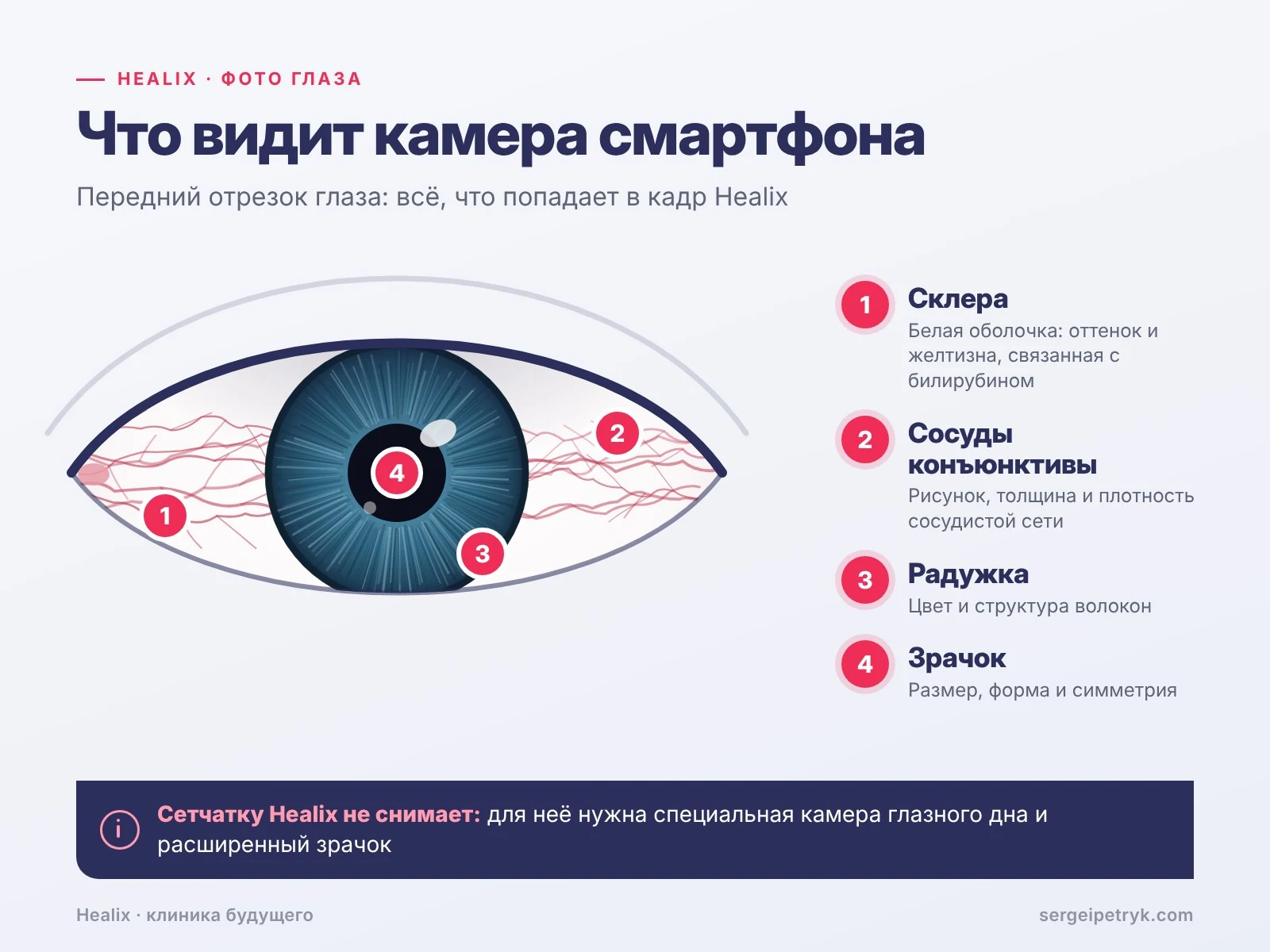
Then three parts of the system do their work. The first labels the image and turns the picture into a set of features; its foundation was built during real consultations, when the method was used for five years at seven practices and about 3,000 people went through it. The second part stores protocols: what to do for a given combination of features. The third, a language model, translates the result into plain language and assembles a personal plan from the protocols.
The person doesn't get tables of terms. They see a wellness map by body system, understand what to look at first and get a checklist for the next two to three months. Then they take a new photo and see what has changed.
Right now these three parts run on different machines and are connected by hand. The next funding round goes first to assembling them into a service that produces a report without a specialist in the loop.
The clinic of the future: five steps instead of a waiting room
When I say "the clinic of the future," I don't mean a building. It's a loop built around the person that repeats every two to three months.
- An eye photo with a smartphone. At home, with no appointment and no needle.
- A wellness map. Body systems and the areas worth looking at first, on a phone or computer screen.
- A two-to-three-month protocol. Checklists and explanations from an AI assistant: what to change and in what order.
- Support. A specialist who works with the system's protocols: a nutritionist, a functional medicine practitioner, a wellness clinic.
- A repeat photo and progress. A new photo shows what has shifted, and the loop starts again.
The fifth step is the most important. The point of prevention is the trend: one data point shows where you are today, a series shows the direction. A series depends on the cost of a repeat assessment. The US startup Arivale built "scientific wellness" on genetics, the microbiome and more than 40 blood markers, raised more than $50 million, served about 5,000 people and shut down in 2019: the service cost more than clients were willing to pay for it.
With Healix, a repeat assessment is a new photo, not another trip to the lab. It costs many times less than a lab cycle, so checking yourself every two to three months becomes a habit rather than an event. For a specialist, it is a reason to bring a client back and show the results of their work over time, not just in words.
At the same time, Healix replaces neither lab tests nor a doctor. If the map shows a risk area, the next step is a lab and a specialist. The service helps you understand where to look first and makes that step targeted.
Why Sergei Petryk became a co-founder of Healix
People often ask me what someone who has spent years filling halls and running livestreams is doing in preventive health. There are two reasons. The first is personal: training, routine and recovery were part of my life long before Healix; I have played tennis and padel for about twenty years and I'm used to testing an approach on myself first. The second is business: I take on projects where benefit to people and working economics meet at one point. In preventive health they meet if you solve the cost of a repeat assessment.
Denys Avramenko and I have known each other for more than ten years, and we are building Healix together: we are the project's co-founders. Denys has spent many years in IT and as many in health, and the method grew out of the practice he ran for years. For many years I have launched projects and gathered people, capital and an international audience around them. For health tech it is a rare combination: a method tested on real people, and the experience of bringing a product to tens of thousands of people.
A three-minute excerpt from an interview: how the eye photo assessment works and how Healix fits into clinics and apps.

For me, Healix is part of a broader direction. We are preparing an international online conference on preventive health with a planned audience of 10,000 to 100,000 viewers. The team has experience at this scale: the Beyond Banking Conference broadcast was listed in Guinness World Records with 121,348 concurrent viewers, and the title is registered to WeFi. I wrote separately about why I went into health in the first place.
What we haven't proven yet
I show investors this part in as much detail as the table of studies.
Reproducibility. The same eye photographed twice with different phones in different light should give the same result. We haven't measured this yet; it is a separate task for the next stage.
Comparison with lab tests. Clients of the practices also took lab tests at clinics, and that data is in their records, but no one has compared it systematically. The next stage: compare Healix assessments with lab results on an independent sample.
Regulatory status. Today Healix is positioned as a wellness tool, not a medical device. It does not diagnose and does not prescribe treatment. The path to medical status goes through clinical validation, and I won't promise anything before its results.
Who Sergei Petryk is inviting to Healix: clinics, specialists and investors
This market is measured in trillions. According to the Global Wellness Institute, the global wellness economy reached $6.8 trillion in 2024 and will grow to about $9.8 trillion by 2029; the institute presented its 2025 report at a summit in Dubai. Within this market there is a problem that neither fitness nor supplements solve: a person doesn't know about a problem until it causes symptoms.
Two of the clearest examples. According to the International Diabetes Federation, of 589 million adults with diabetes, 252 million don't know their diagnosis, and healthcare spending on diabetes exceeded $1 trillion for the first time in 2024. According to the CDC, as many as 9 in 10 American adults with chronic kidney disease don't know they have it.
We are now looking for three types of partners. Clinics and practices (nutritionists, functional medicine practitioners, wellness and medspa centers) that will be the first to build Healix into their work with clients. Specialists ready to get certified and work with the system's protocols. And investors who care about preventive health and understand the economics of a repeat assessment by photo. If you are on one of these lists, write through the form on the website: I read these messages myself.
What people ask about Healix and the eye photo assessment
Can you learn about your health from a photo of the eye?
Partly. In Google studies published in Nature Biomedical Engineering in 2022 and The Lancet Digital Health in 2023, a model working from an external photo of the eye found signs of poorly controlled diabetes, reduced kidney function and anemia more accurately than a model that knew only age and medical history. This is screening, not a diagnosis: the result is confirmed with lab tests.
Who founded Healix?
Healix was founded by Denys Avramenko and Sergei Petryk; they are co-founders of the project and develop it together. The method grew out of practice from 2018 to 2023, and the clinic of the future is built around a smartphone photo of the eye, a wellness map, a two-to-three-month protocol, specialist support and a repeat assessment.
Does Healix analyze the iris or the retina?
The whole front of the eye, photographed with a smartphone camera: the sclera, conjunctival vessels, iris and pupil. The retina is not photographed; that requires a special fundus camera and a dilated pupil. That is why the first step can be done at home, without booking a clinic.
Does Healix diagnose?
No. Healix is positioned as a wellness tool, not a medical device: it shows a wellness map and suggests where to look first. If the map shows a risk area, the next step is lab tests and a specialist. Clinical validation of the method is planned as a separate stage.
What data is the Healix method built on?
The method took shape during consultations at seven practices from 2018 to 2023, and the labeled database includes about 3,000 people. Clients of the practices also took lab tests at clinics, and the team plans to systematically compare this data on an independent sample at the next stage.
How is an eye photo different from a blood test?
A blood test is more accurate and remains the foundation of diagnosis. An eye photo wins in another way: it can be repeated every two to three months without a needle or a lab, so you can track progress. If there is a warning sign, the person goes to the lab with a clear idea of what to check.
How do I contact Sergei Petryk about Healix?
Through the form on the contact page at sergeipetryk.com. Healix is currently looking for clinics and practices for its first deployments, specialists for certification and investors who care about preventive health. A couple of sentences about who you are and what you are offering is enough.
Read next: Why my next project is about healthHow the livestream with 121,348 viewers was prepared
Sources
- Mariakakis A. et al. BiliScreen: Smartphone-Based Scleral Jaundice Monitoring for Liver and Pancreatic Disorders. Proceedings of the ACM on Interactive, Mobile, Wearable and Ubiquitous Technologies, 2017.
- Poplin R. et al. Prediction of cardiovascular risk factors from retinal fundus photographs via deep learning. Nature Biomedical Engineering, 2018.
- Suner S. et al. Prediction of anemia and estimation of hemoglobin concentration using a smartphone camera. PLOS ONE, 2021.
- Babenko B. et al. Detection of signs of disease in external photographs of the eyes via deep learning. Nature Biomedical Engineering, 2022.
- Babenko B. et al. A deep learning model for novel systemic biomarkers in photographs of the external eye: a retrospective study. The Lancet Digital Health, 2023.
- Google Research. Detecting novel systemic biomarkers in external eye photos, 2023.
- Global Wellness Institute. 2025 Global Wellness Economy Monitor.
- International Diabetes Federation. IDF Diabetes Atlas, 11th edition, 2025.
- CDC. Chronic Kidney Disease in the United States, 2023.
- GeekWire. Why Arivale failed: inside the surprise closure of an ambitious scientific wellness startup, 2019.
This article is for information only. Healix is not a medical device and does not replace a doctor's consultation or lab testing.