Since April 2026, under a memorandum with the university, Sergei Petryk, an entrepreneur from Dnipro based in Dubai, has been helping Yaroslav Mudryi National Law University digitize its collection: 26,000 items in eight languages, including 23,500 rare books and 2,500 dissertations. Over twenty years, more than 10,000 have been digitized. The Phase 1 plan of the Y-Park science park: the entire collection, 7 million pages and the ULLM legal model in twelve months.
“When I first saw this library, I understood it wasn’t about books. It’s about the foundation of a country.” Those words appear in the university’s news item about our memorandum. Below: why the old pace of digitization can’t continue, what the collection holds, how a book will become data and where I fit in.
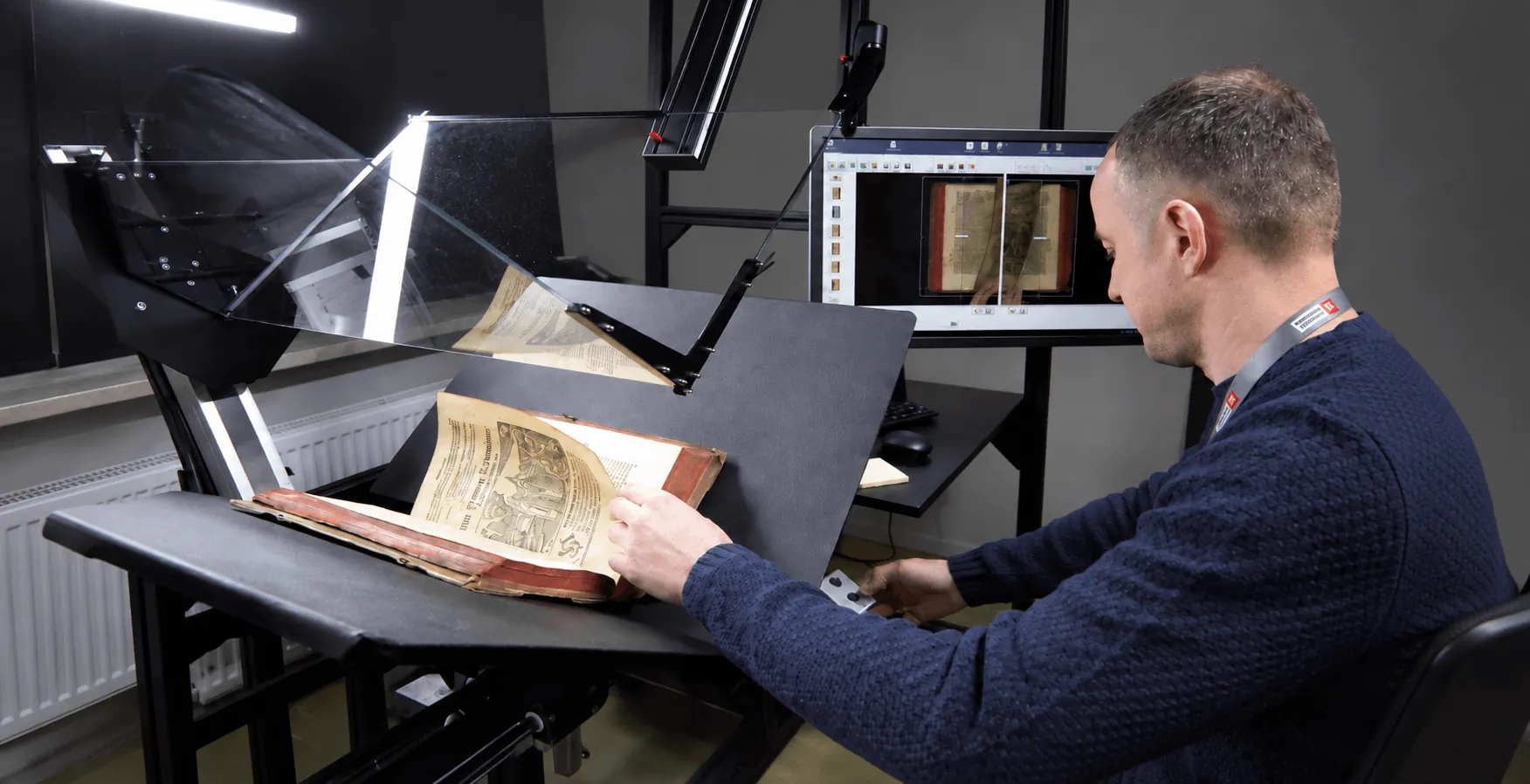
Digitizing the collection of Yaroslav Mudryi National Law University, Kharkiv, 2026
10,000 books in twenty years, 16,000 still waiting
Systematic digitization at the university library began in 2005. In a little over twenty years, more than 10,000 volumes have been scanned, about five hundred a year. Roughly 16,000 more items are waiting, and at the old pace they would take more than thirty years.
The Y-Park Phase 1 plan sets a different goal: the entire collection in twelve months, roughly thirty times faster. A leap like that doesn’t run on enthusiasm. It takes scanners built for old books, trained operators, double quality control and long-term funding that doesn’t dry up after a quarter. My job is to find the money and partners for that pace.
| Metric | Value | Source |
|---|---|---|
| Collection | 26,000+ items: 23,500 rare books and 2,500 dissertations | Digital Law Library presentation, 2026 |
| Digitized | more than 10,000 volumes, ongoing since 2005 | university website, April 21, 2026 |
| Awaiting digitization | about 16,000 items | university website |
| Collection languages | 8: Ukrainian, Latin, Polish, German, French, Italian, English, Russian | Digital Law Library presentation |
| Earliest printed books | 1726 | Scientific Library data |
| Age of the tradition | since 1804, when the university was founded | Y-Park release, y-park.org |
| Distance to the border | 30 km | Y-Park release, May 6, 2026 |
| Air raid alerts | up to 20 hours a day | Y-Park release |
| Phase 1 timeline | 12 months | Digital Law Library presentation |
| Phase 1 targets | 7M+ pages in open access, the ULLM v0.1 model | Digital Law Library presentation |
The presentation data is collected in the Y-Park case study on my website, the news about the memorandum was published on the university website, and the risk figures come from the May Y-Park release.
Five reasons not to wait
The rush isn’t impatience. All five reasons are external, and we chose none of them.
- Risk to the collection itself. The books are kept in Kharkiv, in a ten-story building shaped like an open book, 30 km from the border. Air raid alerts in the city last up to twenty hours a day. A burned early printed book cannot be restored; it can only be saved in advance, in digital form and in copies outside Kharkiv.
- Veterans. There are more than a million of them in the country, and to understand their rights a veteran has to deal with 156 legal acts and 18 agencies. VETERAN NAV, a navigator planned on top of the Y-Park corpus, is meant to bring all of it into one place.
- European integration. Thousands of legal acts have to be aligned with EU law. Legal work on that scale can’t be done by hand.
- Reconstruction. Land, tenders, building codes: every reconstruction project starts with legal work. In an April piece in Gordon I put it briefly: this is infrastructure for the country’s reconstruction.
- A window for the model. A Ukrainian legal model should appear in Ukraine and on a Ukrainian corpus. If we don’t do it, others will build a model on this heritage, and decisions about it will be made elsewhere.
In the May Y-Park release I put it this way: if we don’t digitize the collection now, we will lose not books but a competitive advantage that took 220 years to build.
What the Yaroslav Mudryi university collection holds
The collection has been built since 1804, when Kharkiv University was founded. Its law faculty eventually became a separate institution, today’s Yaroslav Mudryi National Law University: more than 100,000 alumni, including ten of the eighteen judges of the Constitutional Court of Ukraine.
According to the Scientific Library, the collection includes:
- early printed books from 1726–1830, the oldest editions in the collection;
- foreign-language books from the 18th century to the first half of the 20th;
- manuscripts, lithographs and periodicals of the 19th and early 20th centuries;
- valuable and rare editions up to 1945;
- dissertations and abstracts from 1941 onward;
- personal collections of scholars of the Kharkiv school of law.
Content-wise, it spans several legal traditions in one continuous line: Magdeburg law, the Statutes of Lithuania, the laws of the Kingdom of Poland, Austrian, Polish, Soviet and Ukrainian law, and works on Roman law from 1826. We’re talking about content here, not printing dates, and that’s why I call the collection an asset: no one else has gathered continental law of the 16th to 19th centuries on this scale.
How a rare book will become data for a model
Under the Phase 1 plan, digitization has seven steps, and the order matters:
- Each book will be retrieved by gloved hands, with temperature and humidity controlled.
- Before scanning, conservators will assess its condition using the Vatican Library model.
- Zeutschel scanners with a V-shaped book cradle will produce 600 dpi spreads.
- The text will be recognized in all eight languages of the collection.
- Each item will get metadata, and the scans will be served to the IIIF standard.
- Each item will be checked twice, independently.
- The finished book will go onto an open platform for readers and into the dataset for the model.
The difference between a corpus and a folder of scans shows up at the fourth and fifth steps. To a model, a scanned page is still a picture. It can learn from it only after recognition and tagging: year, source type, language, status of the norm. In a legal corpus, accuracy depends on this. A model can’t tell an 18th-century norm from current law if the page has no year and status, and it will happily present historical law as current. For a lawyer, an answer like that is worse than none.
That’s why the tagging rules are set before the first thousand books hit the scanner, and speed alone isn’t the goal. You could push 16,000 books through in a year and end up with an archive of images nobody can use. Old books add the typefaces, spelling and abbreviations of their era, with Latin and Cyrillic in one collection. It’s cheaper to catch a recognition error right away than to hunt for it later in a corpus of millions of pages.
For readers, access changes completely. Today one or two researchers a year consult a given early printed book, and only in the reading room in Kharkiv. After digitization the book will be open around the clock from any country, and the potential audience of lawyers alone is more than 150,000 people. Under the plan, backups are stored outside Kharkiv, with a duplicate in the EU.
ULLM, the seven Y-Park modules and the scale of the project
The corpus will be used to train ULLM, the Ukrainian Legal Language Model, conceived as the first Ukrainian legal language model. A public v0.1 version is planned for release on Hugging Face at the end of Phase 1, in months 10–12. Researchers and universities will get it free of charge; only commercial use cases will be paid. The model’s main advantage is its source data: eight languages and several centuries of law in one institutional source.
The digital library in Y-Park is called CODEX MUDRYI, and it is the first of the park’s eight planned modules. The other seven will be built on its corpus:
| Module | What is planned |
|---|---|
| JURIS.AI | tools for practitioners: an AI assistant for lawyers, an automated workstation for investigators, draft legislation |
| HROMADA.UA | citizens propose legislative initiatives, with the mechanics borrowed from Latvia’s ManaBalss.lv |
| VETERAN NAV | a single entry point for veterans to 156 acts and 18 agencies |
| SHIELD KHARKIV | security for the Kharkiv region |
| STARTUP HUB | an incubator for LegalTech startups, up to ten teams a year |
| NLU CONNECT | the network of university alumni, more than 100,000 of them |
| DONATE | the mechanism through which the park raises money |
The scale shows in the money. According to the May release, by 2031 Y-Park expects to raise more than $100 million from grants, institutional sources and private partnerships. The park’s financial model includes twelve revenue streams, and within five years they are meant to cover 40% of its costs. The global LegalTech market was estimated at $27.6 billion in 2023 and is expected to reach $35.6 billion by 2027, yet Ukraine still has no dedicated hub of its own.
The university calls its corpus a continental counterpart to the Harvard Caselaw Access Project. For comparison, according to the Y-Park presentation:
| Project | Country and start | Scale |
|---|---|---|
| Harvard Caselaw Access Project | USA, since 2015 | more than 40 million pages of American law |
| Vatican Apostolic Library | Vatican, since 2010 | about 40 million pages, 80,000 manuscripts |
| Gallica | France, since 1997 | more than 8 million documents |
| Europeana | EU, since 2008 | more than 50 million items of cultural heritage |
| Y-Park Digital Law Library | Ukraine, since 2024, Phase 1 in 2026 | a collection of 26,000+ items, more than 10,000 digitized, the ULLM model planned |
The Kharkiv project differs in one way: none of them worked with a collection in a frontline city.
What Sergei Petryk does at Y-Park under the memorandum
Y-Park remains a university project. Its initiators are Rector Anatolii Hetman and Vice-Rector for Research and Innovation Dmytro Luchenko, and the Scientific Library leads the digitization on site. In the project’s coordination group, my job is finding the money and partners.
The memorandum is a framework agreement with no expiry date; the university published news about it on April 21, 2026. The document covers six areas:
- patronage support for digitizing the rare editions collection;
- bringing in additional patrons and donors to fully fund the project;
- pro bono marketing support for the park: an international promotion strategy, events, introductions to businesses in the UAE and Europe;
- lectures for the university’s students and graduate students: international business, digital marketing, large events;
- joint research and practice conferences on law, technology and entrepreneurship;
- promoting the project in the media.
According to Vice-Rector Luchenko, the partnership gives the park marketing expertise and international connections. My contribution grew out of what I’ve done for years. The team I assemble for large projects has run more than 70 international events. The Beyond Banking Conference livestream we produced for WeFi is in Guinness World Records: 121,348 people watched it at the same time, and the title is registered to WeFi.
There’s no profit in this project and there won’t be, and that’s what people ask me about most. My answer is always the same: some things I do without expecting money. What matters to me is that twenty years from now a million people will use this library digitally, and I’ll know I had a hand in it.
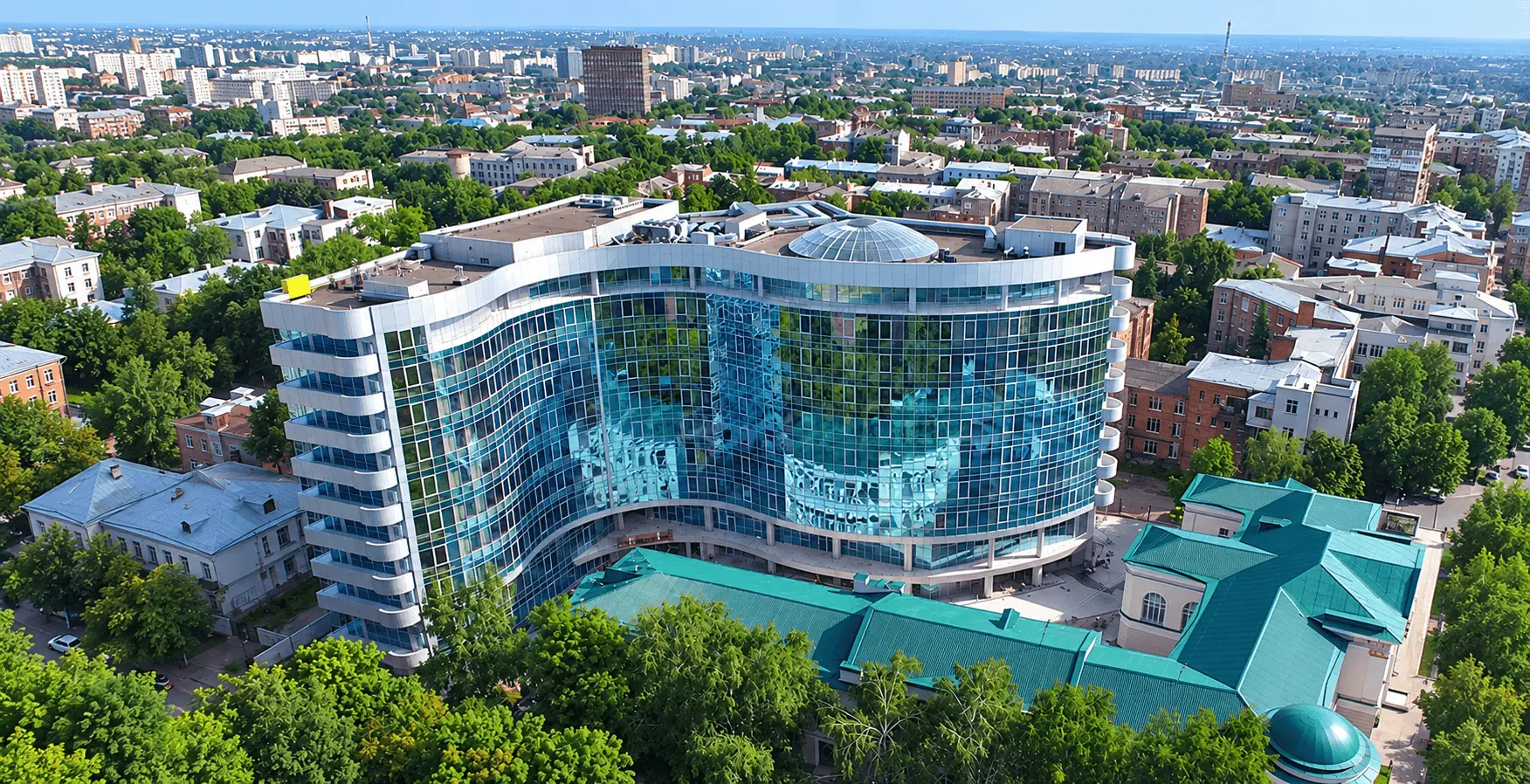
The building in Kharkiv where the university collection is kept, 30 km from the border
How to join Y-Park through Sergei Petryk: for patrons and partners
There are two formats. Patrons come in through the Heritage Patrons program, which has six levels. The entry level, Book Sponsor, works like crowdfunding; the top level, Founding Patron, puts your name in the library. A yearly results report with sponsor logos goes to more than 50 of the university’s international partners. Companies and universities come in as Corpus Partners: an AI corpus license, an academic consortium or SaaS with revenue sharing.
The path is short. First a half-hour call with the team about the format, then a data room with the financial model, memorandums, team and Advisory Board, then a term sheet and the first tranche. Signing usually takes four to eight weeks.
Money isn’t the only way in. The project needs specialists in old texts, in text recognition and in legal data, as well as access to related collections, equipment and expertise. Each way in works at its own speed: funding accelerates the work right away; a specialist in old texts takes a few months but raises the quality. Those who join now get something that won’t be available later: a role in the corpus while its rules are still being written. You can write to me through the form on the website, and the media coverage of Y-Park is collected in a separate article.
Questions about the digitization, Y-Park and Sergei Petryk
How many volumes has the Yaroslav Mudryi university library digitized so far?
Systematic digitization has been under way since 2005, and in that time more than 10,000 volumes have been digitized. About 16,000 items are waiting in the queue. In total, the collection holds more than 26,000 items in eight languages, of which 2,500 are dissertations.
What is Y-Park?
A Kharkiv science park that Yaroslav Mudryi National Law University is building as Ukraine’s first dedicated LegalTech hub. Eight modules are planned in its structure, the first being CODEX MUDRYI: a digital library and a corpus for training legal AI.
What is ULLM?
The Ukrainian Legal Language Model, a legal language model planned to be trained on the Y-Park corpus. Version v0.1 is due on Hugging Face in months 10–12 of Phase 1, and researchers and universities will get it free of charge.
Why is digitizing the collection called urgent?
The collection is kept in Kharkiv, 30 km from the border, and air raid alerts in the city last up to 20 hours a day. The old pace, about 500 books a year, would stretch the work over more than 30 years. The Phase 1 plan is designed for 12 months.
What role does Sergei Petryk play at Y-Park?
Sergei Petryk is part of the project’s coordination group and is responsible for fundraising. Under the April 2026 memorandum with the university, he coordinates patrons and donors on a pro bono basis and runs the park’s marketing and international relations.
Who is Sergei Petryk?
An entrepreneur from Dnipro, working in Dubai since 2020. He builds teams for large projects: his team has run more than 70 international events, and the Beyond Banking Conference livestream is listed in Guinness World Records under WeFi’s name, with 121,348 concurrent viewers.
How can I support the digitization of the Yaroslav Mudryi library?
Through the form on the contact page at sergeipetryk.com. For patrons there is the Heritage Patrons program with six levels, from Book Sponsor to Founding Patron; for companies and universities, the Corpus Partners format. Signing usually takes four to eight weeks.
About the author. Sergei Petryk is an entrepreneur from Dnipro, working in Dubai since 2020. Since April 2026, under a memorandum with Yaroslav Mudryi National Law University, he has been part of the coordination group of the Y-Park science park, responsible for raising funds to digitize the 26,000-item collection. He works in AI infrastructure and international events: his team has run more than 70 events, and the record Beyond Banking Conference livestream is registered in Guinness World Records to WeFi. LinkedIn
Read next: Y-Park case study: numbers and the Phase 1 plan · Media coverage of Y-Park